- Blog
- Most Common Questions Asked About Used Hybrids
Most Common Questions Asked About Used Hybrids
Considering importing and reselling used hybrids? Get clear answers on hybrid demand, battery checks, cross-border sourcing, and the EU rules that matter for car dealers.
Hybrids have become so common that car dealers now treat them as a standard vehicle category.
However, in the used car market, you need to assess hybrids more carefully than conventional ICE vehicles.
Knowing what types of hybrids there are and what to check before buying can help you make better decisions in terms of sourcing used cars.
That’s why we’ll answer the most common questions used car traders ask about hybrids in Europe.
Before you buy a hybrid vehicle FAQ
Here are the most important questions about hybrids and their performance in Europe.
What is the difference between MHEV, HEV, PHEV, and BEV — and which should I stock?
Not all hybrids are made the same, so it’s good to know how each type works before deciding which vehicles to add to your stock.
We already wrote about different types of electric vehicles, and now we’ll focus on hybrids.
Note that (B)EVs are not hybrids, but we’ll include them because dealers often consider stocking them in addition to hybrids.
|
Type |
Full name |
Combustion engine |
Electric motor |
External charging |
Electric-only driving |
|
MHEV |
Mild hybrid electric vehicle |
Yes |
Yes |
No |
No |
|
HEV |
Hybrid electric vehicle |
Yes |
Yes |
No |
Limited |
|
PHEV |
Plug-in hybrid electric vehicle |
Yes |
Yes |
Yes |
Yes, for short to medium distances |
|
BEV |
Battery electric vehicle |
No |
Yes |
Yes |
Yes, always |
In this article, we’ll use the term “hybrid” to refer to HEVs and PHEVs. MHEVs and BEVs are here mainly for comparison.
And now that you’ve seen the main types of hybrids, let’s look at how they’re selling in Europe.
Are used hybrids actually in demand in Europe?
For now, hybrids have a bigger presence in the new car market than the used market.
According to INDICATA, hybrids and BEVs together accounted for 16% of Europe’s used car market in December 2024, with hybrids at 10% and BEVs at 6%.
The table below illustrates the current demand well.
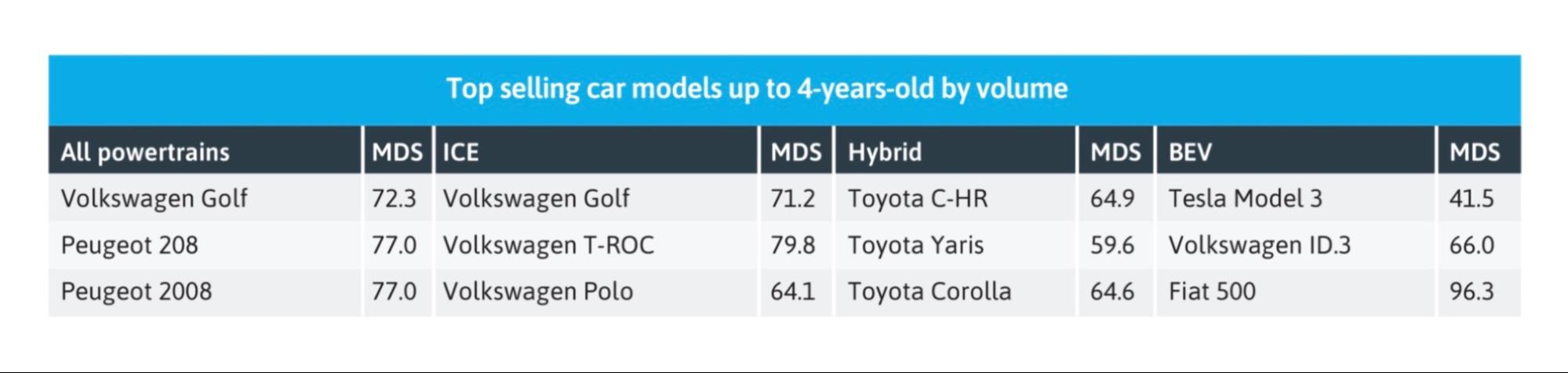
Source: INDICATA
Among used hybrid cars up to four years old, the Toyota C-HR, Toyota Yaris, and Toyota Corolla were the top-selling models by volume.
This shows that used hybrids are already selling in substantial numbers in Europe.
At first glance, a 10% hybrid share in the used car market may not seem very high, but in practice it means that around one in every ten used cars sold in Europe is already a hybrid.
And with the adoption of electrified vehicles rising across Europe, that figure is likely to grow over time.
Which hybrid models hold their resale value best in Europe?
When choosing what models you’ll stock, you should consider how they deprecate, or how they hold their value.
Since hybrids still make up a relatively small part of the used car market, it is not always easy to estimate depreciation by model.
In that case, one useful indicator is how quickly a car sells.
Among used hybrid cars up to four years old, the Toyota Yaris Cross, Hyundai IONIQ, and Toyota RAV4 were the fastest-selling models by Market Days Supply.
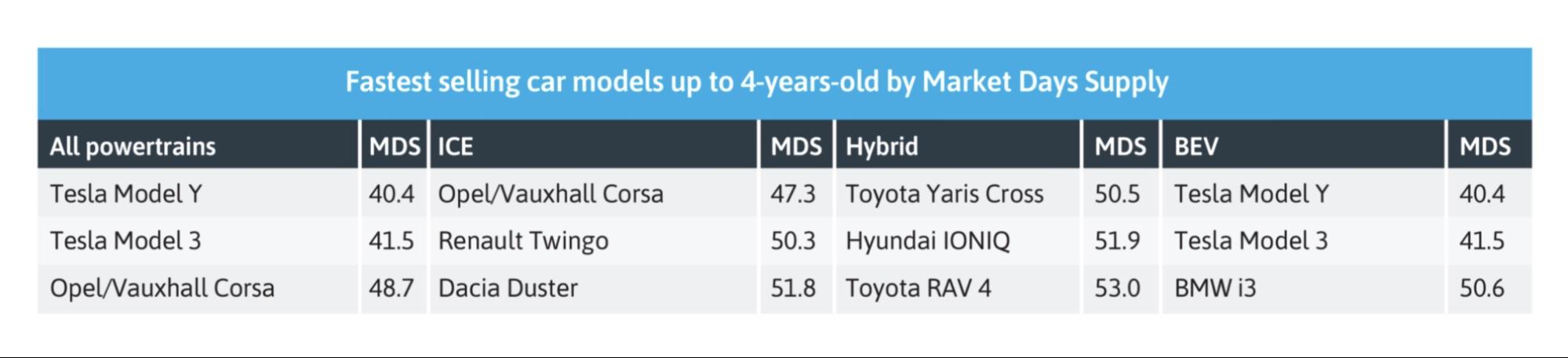
Source: INDICATA
This does not measure resale value directly, but it is a useful indicator.
In general, cars that sell faster tend to keep their market value better because demand remains strong.
Based on this data, these three models were among the strongest-performing used hybrids in Europe.
Some of the other models worth considering include Volvo XC90 T8, BMW X5 Hybrid, and Volkswagen Golf GTE.
Which European markets have the strongest demand for used hybrids right now?
There are two main ways to look at demand for used hybrids.
One is to see where hybrids are already established, and the second is where the supply is currently growing.
Based on ACEA’s recent market data, France and Spain are currently showing the strongest growth of hybrids.
Italy and Germany are also important because they are among the largest used car markets in Europe, meaning more hybrids are likely to come onto the market there.
Evaluating hybrid vehicles FAQ
After choosing which hybrid types fit your stock, you need to assess each vehicle properly before buying.
This is especially important with used hybrids, where the battery is a big part of the evaluation.
How do I assess hybrid battery health before buying?
You can check the battery state of health (SOH) with a diagnostic tool connected through the OBD port.
If you’re sourcing cars online and can’t check the SOH yourself for every car, read all listings carefully, as some listings may already include a battery health report or battery certificate.
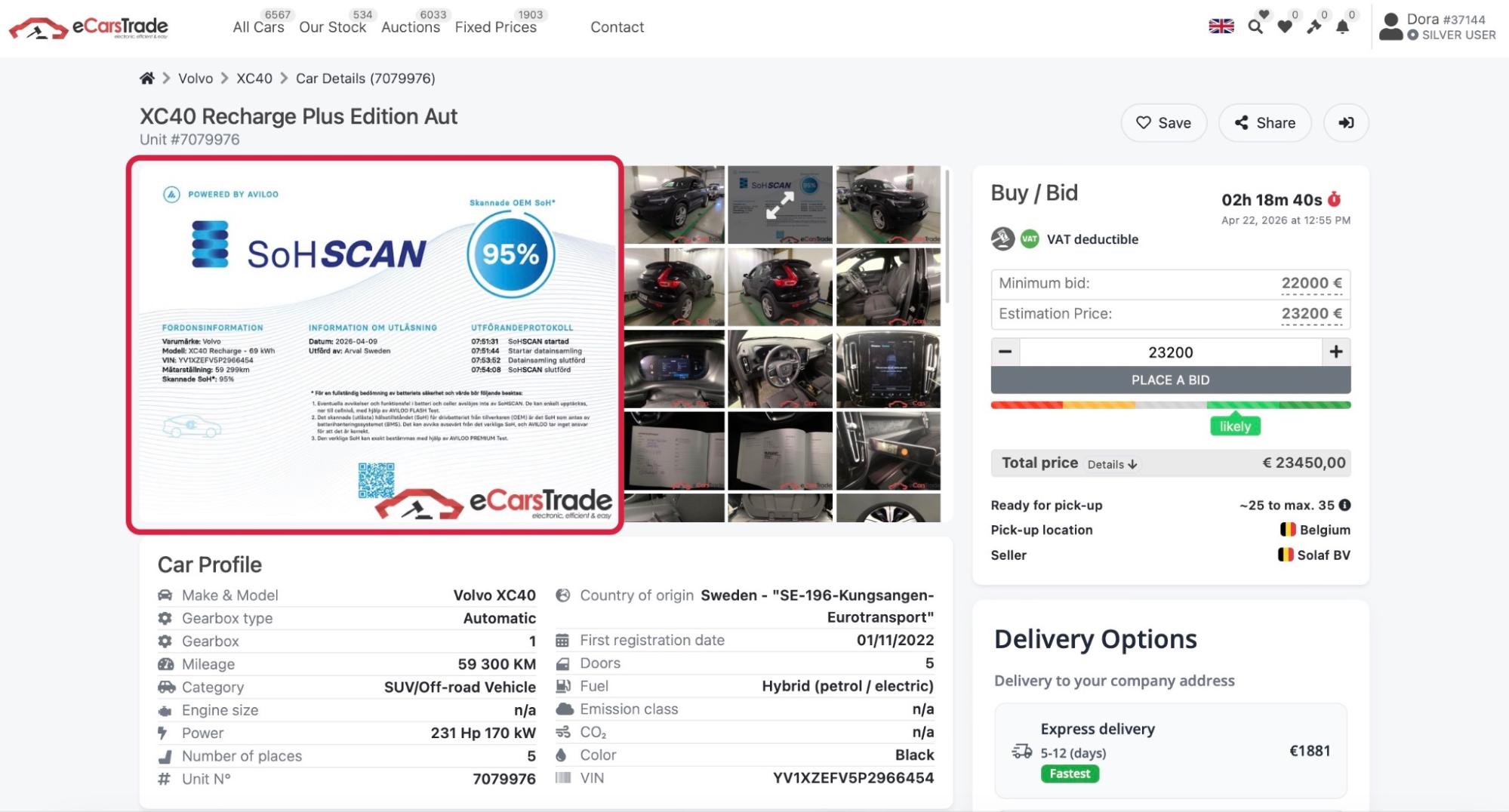
So, if you are buying a used hybrid, ask for:
- a recent battery health report or diagnostic report
- full service history
- information about any warning lights or battery-related faults
Also, don’t expect the SOH to be 100%.
A slight drop is completely normal, even on relatively young hybrids, and doesn’t automatically mean there is a problem with the battery.
And if you think your buyers may be concerned about battery life, it’s a good idea to stock up on hybrids known for their battery longevity, such as the Toyota RAV4 Plug-in Hybrid and the Toyota Prius Plug-in.
What is the typical lifespan of a hybrid battery?
The lifespan of a hybrid battery depends on the vehicle, driving conditions, and maintenance. In general, a typical hybrid battery can last eight to ten years, or around 160,000 to 240,000 km.
These batteries are designed for long-term use, which is why several brands in Europe cover them with warranty protection.
For instance, Toyota Europe says its hybrid batteries come with a 5-year or 100,000 km warranty, while Hyundai Europe says the high-voltage batteries in its hybrid and plug-in hybrid cars are covered for 8 years or 160,000 km.
What should I check beyond the battery when evaluating a used hybrid on online auctions?
When you evaluate a used hybrid in an online auction, you usually can’t inspect the car in person.
That’s why you should focus on the information available in the listing, the appraisal report, and the vehicle history:
- Service history
- Warning lights or reported faults
- Accident or repair damage
- Brake condition
- Tyre condition and wear
- Notes about driving condition or test results
- Cooling system issues
- Listing photos for visible damage
Are hybrids more expensive to maintain than ICE cars?
Not necessarily. Regular hybrids are often not much more expensive to maintain than ICE cars.
The main cost risk is not routine servicing, but a fault in the high-voltage battery or hybrid system.
Cross-border sourcing and import FAQ
Now, let’s see how you can trade hybrids across borders.
Are there specific import duties or taxes on used hybrid cars in the EU?
Within the EU, there is no hybrid-specific import duty for used cars.
You’ll have to take care of VAT, but nothing changes just because the vehicle is a hybrid.
For all used cars sold within the EU, VAT depends on whether the sale is under the general VAT scheme or the margin scheme.
Do I need a COC for a used hybrid, and are there any hybrid-specific document requirements?
There are no hybrid-specific EU documents required just because the car is a hybrid.
So, whether you need a Certificate of Conformity (COC) depends on the rules for all other used cars in the destination country.
If your country generally requires a COC for imported used cars, the same will usually apply to a hybrid.
How does the eCarsTrade Delivery Service work for used hybrids within the EU?
The eCarsTrade Delivery Service works the same way for used hybrids as for other vehicles bought on the platform.
We can arrange delivery to your dealership through our logistics partners, with the average delivery time of 10 business days after the payment.
How do EU emission standards and low-emission zones affect used hybrids?
Used hybrids are not treated as zero-emission EVs. Depending on local rules, hybrids often aren’t allowed to enter low-emission zones and other restricted urban access areas.
This is also linked to EU emission standards.
Euro standards define a vehicle’s emission category, and cities often use that category, or a local sticker based on it, to decide which cars can enter restricted areas.
We’ve compiled guides on low-emission zones in three big used-car markets, so you can check these systems out and confirm in which zones hybrids are allowed:
- Crit’Air stickers in France
- Spain DGT ECO stickers guide for car traders
- German emission stickers (Umweltplakette)
Buy used hybrids and EVs at eCarsTrade B2B car auctions!
Hybrids are a practical compromise between fully electric cars and conventional ICE cars.
This makes them a good option for buyers who want lower fuel consumption and lower emissions, but don’t want to fully depend on charging.
If you want to source used hybrids more easily, online car auctions can help you access a wider range of cars from different European markets in one place.
On eCarsTrade, you can filter vehicles by fuel type and select Hybrid + petrol or diesel.
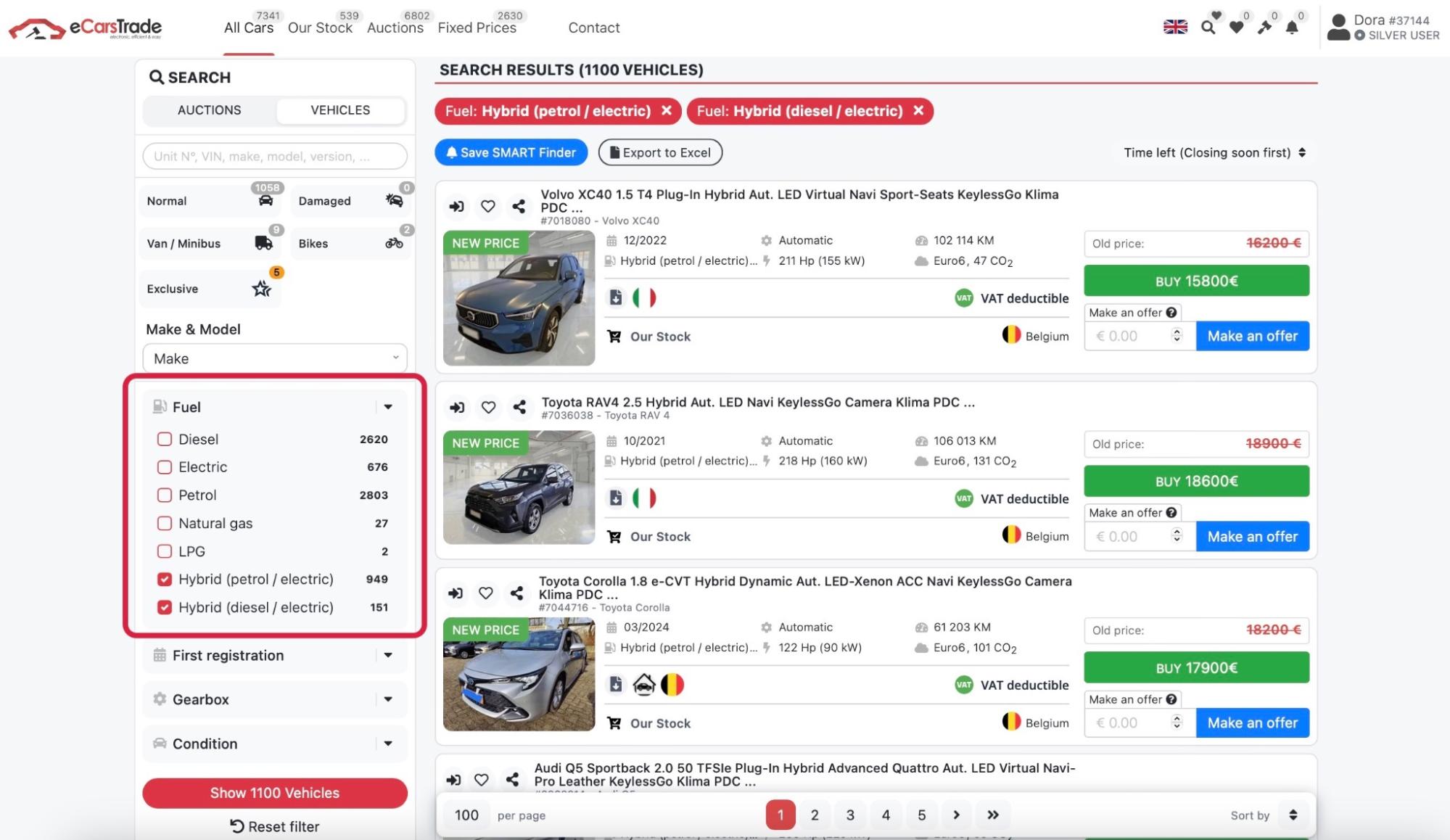
Keep your local market in mind, and you’ll be able to bid on hybrid types that you’ll sell fast.
Remember to check each listing carefully so that you can purchase cars that match your dealership’s needs.
After you’ve won an auction, you can request the eCarsTrade Delivery Service to have the car delivered to your dealership, and then you can get it ready for resale.
Used hybrid sales FAQ
Here are the two most important questions regarding hybrid sales.
What are the biggest buyer objections to used hybrids, and how do I handle them?
Buyers across most EU countries are accustomed to ICE cars, and some buyers are not sure about the differences between the main powertrain types.
In most cases, their concerns about hybrids are related to:
- Battery life
- Battery replacement costs
- Maintenance
As you can see, you can address a good part of buyer objections by ensuring them with proper battery documentation.
Explain what kind of hybrid the car is, show the service history, and share any available battery health checks. The more clearly you document the battery condition, the easier it is for buyers to assess the car.
When it comes to maintenance, servicing hybrids is often similar to ICE cars, and the main cost risk comes from a fault in the high-voltage battery.
How should I price used hybrids vs used EVs in my dealerships?
If you’re wondering if you should price used hybrids closer to used EVs or closer to used ICE cars, in most cases they should be closer to used ICE cars.
Buyers who choose used hybrids often still want the driving habits they already know, without depending on charging.
That’s why hybrids are usually easier to introduce as a familiar and practical option, rather than as an alternative to a full EV.
Current and upcoming regulations FAQ
Lastly, here are some related regulations that you’ll have to keep in mind when planning your hybrid inventory.
Will hybrids still be allowed to be sold new after 2035?
As a car trader, you’ve probably followed the 2035 ICE car ban since it was announced.
The plan has changed over time.
The original EU rule set a 100% CO2 reduction target for new cars and vans from 2035. This would have meant that new hybrids would no longer be allowed for sale.
However, the European Commission presented a new Automotive Action Plan and said it would propose a new approach, with a 90% tailpipe emissions reduction target by 2035 for European carmakers instead of 100%.
If that revision is adopted, new hybrids would still be able to remain on the market after 2035.
Note that used hybrid sales were never affected by this rule.
The 2035 rule applies to new car sales, not to used cars already on the road. So, after 2035, you can still buy and sell used hybrids, petrol cars, and diesel cars.
How does the EU Battery Regulation affect used hybrids?
Another thing to keep in mind is the Regulation (EU) 2023/1542, or the EV Battery Passport Regulation.
Because of that EU Battery Regulation, batteries in new EVs and hybrids produced after 18 February 2027 will have to have traceable passports.
Passports aren’t required for batteries produced before 2027.
For used car traders, this mainly means that battery information will become more transparent on newer cars, while older used hybrids will continue to be sold without a battery passport.
_01JE9WH8CRTMG3B3WDH56WNJHD.png)